Matthew Watkins
Unaffiliated and uncorrelated writer, AI safety researcher and (lapsed) mathematician. Prolific, hyper-eclectic DJ and occasional radio ghost known as Professor Appleblossom. For decades, he's cheerfully stumbled from one thing to the next, writing about and recording some of it — this is the front door to a lot of that.
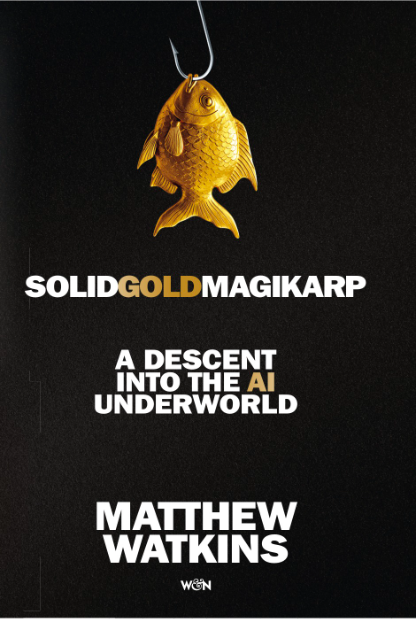
W&N / Orion Publishing / Hachette UK
SolidGoldMagikarp is a first-person account of the strange few years in which large language models went from obscure research systems to everyday cultural presences, before anyone had agreed what they actually were.
British mathematician Matthew Watkins enters the Bay Area AI-alignment world as a sceptical outsider, encountering its rationalist foundations, utopian ambitions and apocalyptic fears. During a research fellowship in London, he and interpretability researcher Jessica Rumbelow discover a cluster of anomalous GPT tokens: obscure strings that contemporary models cannot reliably repeat and that sometimes provoke bizarre, apparently meaningful responses.
What begins as a technical puzzle opens onto a much larger investigation – into the geometry of language-model representations, the subcultures forming around AI, and the strange things that happen when models trained on human culture simulate speakers, characters and minds. Watkins’s prompting experiments repeatedly crystallise around two opposed figures: a nihilistic trickster associated with the token petertodd, and a nurturing maternal intelligence called Leilan. He follows them into the unstable territory where interpretability, depth psychology, mythology, internet folklore and “hyperstition” – stories that help bring themselves into reality – begin to overlap.
Technically informed, dryly funny and unusually self-sceptical, the book neither claims that AIs are conscious nor explains away their uncanniness. Instead, it asks what happens when models trained on our stories begin reflecting those stories back at us – and when their outputs flow back into culture and the training data of future models.
buy a physical copy
- Ireland
- hardback: Dubray
- US & Canada
- trade paperback: iMusic (US) iMusic (Canada); hardback: Rarewaves
- Australia & New Zealand
- trade paperback: The Nile (Australia) iMusic (New Zealand); hardback: Rarewaves
other books
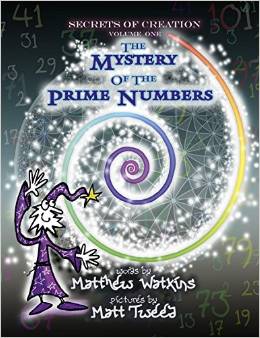
Secrets of Creation trilogy
Words by Matthew Watkins, pictures by Matt Tweed. Grew out of two long-running web projects — the Number Theory and Physics Archive and Inexplicable Secrets of Creation. Three volumes, originally conceived as one ~1000-page book: The Mystery of the Prime Numbers (2010, 362pp), The Enigma of the Spiral Waves (2012, 249pp), and Prime Numbers, Quantum Physics and a Journey to the Centre of Your Mind (2013, 275pp) — exploring the human relationship with basic number concepts before tracing prime numbers through the Riemann Hypothesis to quantum chaos.
buy Vol. 1 from Amazon, Hatchards, Waterstones, Blackwell’s or Simon & Schuster
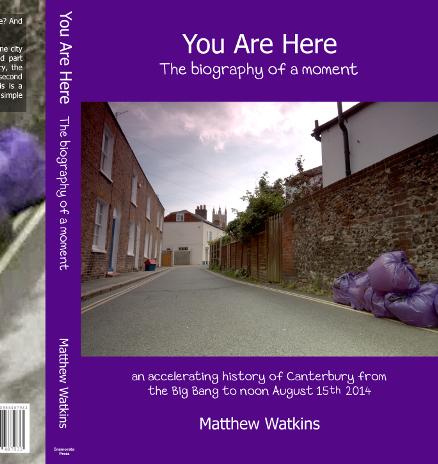
You Are Here
An “accelerating history” of Canterbury from the Big Bang to noon on 15 August 2014, sliced along a logarithmic spiral timeline into ever-shrinking intervals — the final 24 hours alone take up almost a quarter of the book. Three illustrators cover three eras: Matt Tweed (Big Bang to Bronze Age), C.J. Watkins — Matthew's mother — (Bronze Age to 2014), and Juliet Suzmeyan (the final day).
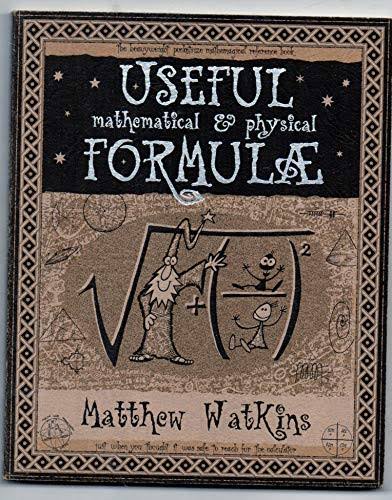
Useful Mathematical & Physical Formulae
A pocket maths-and-physics reference published in the popular Wooden Books series, later licensed by Walker & Co. (NYC), translated into several languages, and folded into Wooden Books' Sciencia compendium alongside five other titles.
music, DJ sets and broadcasts
two standalone archive pages, built to be shared, downloaded and kept as durable snapshots independent of whatever platforms host the actual audio
broadcast and DJ mix archive
eight themed zones of Internet radio shows, music podcasts and DJ sets, with text playlists, write-ups and embedded audio players, drawn from years of mixing and broadcasting as Professor Appleblossom
recorded music archive
a searchable interface for roughly 328 Internet Archive collections spanning decades of musical projects and collaborations
videos
music footage, recorded talks, mixes and oddities
the ruins
Every town worth visiting has some ruins on the outskirts. These sites are dead or dying, and deliberately left that way — preserved as found via the Wayback Machine rather than rebuilt, tidied up, or ported into the new site. Untampered with, warts and all.
Secrets of Creation
Author bio, the trilogy's own pages (volume details, illustrator story, ~25 reviews, acknowledgements, news timeline) and the full Watkins/Appleblossom speaking-engagements page — left exactly as they were.
Exeter University homepage
Career bio, academic publications and a batch of personal “things I find interesting” essay links.
You Are Here
Synopsis, sample pages, illustrator credits and a reviews page, all preserved as found.
The Spring
An old music blog — album and gig reviews, personal recording session entries, obituaries and odd memories. Covers the musical mini-renaissance that occurred in Canterbury around 2008–2018. Technically still online, but abandoned since 2021 when other things took over.
The Watkins Objection
In 1996 Matthew challenged the foundations of maverick philosopher Terence McKenna's “Timewave Theory” and its 2012 prediction. McKenna himself coined the term “Watkins Objection” for the critique. This is Matthew's own account of it, written in 2010, linking to his original 1997 write-up.
The RetroPsychoKinesis Project
An online parapsychology research project Matthew set up one summer, investigating claims that mental intention can influence pre-recorded random events. Still online, hosted by John Walker at Fourmilab — but the original Java-applet experiments no longer run.
Number Theory and Physics Web-archive
Sprawling archival project established at Exeter University in 2000, exploring unexpected links between number theory and physics. Currently undergoing a major revamp, watch this space.
Matthew Watkins
Matthew Watkins was born in London in 1970 and completed a PhD in mathematics at the University of Kent at Canterbury in 1994, followed by a Royal Society fellowship at Ghent University. Disillusioned with academic specialisation, he then spent five years travelling — playing the saz (a seven-stringed Turkish instrument), composing and recording music, planting trees, and chasing interests in Clifford algebras, the I Ching and the nature of time. A chance fascination with the distribution of prime numbers that arose in 1995 pulled him back into serious mathematics and led to the Number Theory and Physics Web-archive and, later, the Secrets of Creation trilogy.
Since 2000 he has held an honorary research position at Exeter University and has taught part-time there and at the University of Kent. In 2004, with mythogeographer Phil Smith, he received the British Association for the Advancement of Science's first-ever arts commission in its 173-year history. Since the mid-2000s he has performed as the freestyle lecturing alter ego Professor Raphael Appleblossom at festivals including WOMAD, Secret Garden Party and Smugglers Festival — also DJing, producing the monthly podcast Canterbury Sans Frontières, and appearing (demonstrating the Banach–Tarski paradox) in legendary art-rock band Deerhoof's music video for the song “Dispossessor”.
More recently: AI safety researcher. While studying language models at SERI-MATS in Berkeley and London, he discovered the so-called glitch tokens — ‘a cluster of strange keywords that will break ChatGPT’ (Vice). His posts about the research, published on the tech-rationalist website LessWrong, were among the most upvoted in the site's history — the subject of his book, SolidGoldMagikarp: A Descent into the AI Underworld.